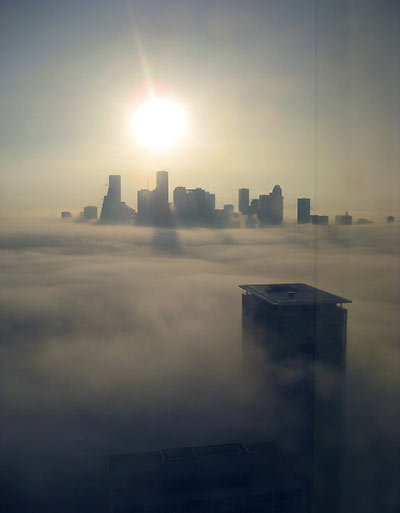
"The goal is a dynamic vision, with systems regulated by processes of energy exchange, which exteriors that dissipate, consume, and capture energy: in short, complex organizations defined to manage energy through their formal characteristics, technical devices, and material definition, all at which evolve over time. A system that exchanges energy with the environment it is situated within... The goal is to define meteorological fields and landscapes of small scale. (Energies Volume 79, Issue 3, Amid Cero9)
This quote I believe exemplifies the goals of my project. Found within the Energies issue of Architectural Design, Amid Cero9 designs systems rather than simply architecture-- the goal of my project as well.
Because of Catie's timing of distributing readings to me, logical next developments to my project seem to jump at my from within the text of the journals. This week was the AD journal Energies. From looking at works from architects such as Sean Lally, Philippe Rahm, and Mark Dorrian, I have come to realize that the most important energy within my project is not water, but is in fact heat- transferred through water. The very different temperatures required through the various programs seen in my earlier diagram coupled with the idea of different levels of comfort enjoyed by humans (contradicting the idea of a perfect 72 Degrees and 74% humidity level) has compelled me to develop a system of heat transfer through the various piping supplies of water. 6 systems will be employed- a hot purified water system, a cold purified water system, blackwater system, purified-non thermally augmented water, brewing transfer system, and a greywater system. Each will transfer water at different temperatures. These systems will move vertically through the structure, and eventually exist as the heating method of the building when the construction of the building completes. I intend to redesign the lofts around a new organizational method based on thermal gradients, which i hope will redefine the way lofts are lived in.
These heat transfer systems, in their first stage, when snaking up the interior of the structure will condition the spaces to different thermal gradients. Comfortable areas will be chosen by the users based upon what temperature and humidity level seems most appropriate to them. I hope to end the dependence upon digital readings of temperatures which conditions a person to enjoy a temperature merely because it is the average comfort temperature of a human. In fact, I enjoy various temperatures throughout the day, based on my mood, activity level, and relative level of exhaustion. My body even requires separate temperatures. When falling asleep, my feet frequently are much colder than the rest of my body, and need to be warmed up before I can fall asleep.
These heating/ plumbing systems will transform and expand and contract while traveling up the structure based upon the demands of each program. In some spaces and floors, the plumbing systems will be minimal, in others the systems may be so massive that they may even develop into furniture or structural supports.
Based upon my analysis of the needs of each program, I have developed a diagram of the placement of each program in the structure vertically. (Unfortunately, because I am home in Alpena this weekend I do not have access to a scanner so I cannot scan any of my sketches in at this point) The brew pub will exist on the bottom floor, with various parts of the brewing process existing on other floors depending upon the relevant temperatures needed of the processes. The car hostel will be on the second floor. the cranberry bog will be on the 3rd and 4th floors. The fish farm will exist as separate tanks on the 3rd, 4th, and roof floors, and the pool/ hot tub will be on the top floor.
One part of the system that I am having issues resolving is the organization of the car hostel. This is certainly not the first time a designer has had difficulty fitting a parking structure that requires an 80 foot width in a 60 foot residential width space. I do not want the car hostel to be organized similarly to a parking structure, but it is very difficult to both allow cars to park and circulate. To merely develop a double helix type parking, I have to extend the floors 8 feet further on the east and west sides of the structure. Beyond hanging the cars off of the side of the building like I had sketched earlier, all other methods of organization of the hostel limit its potential to hold cars so much that it is unrealistic. Furthermore, in order to have the heating/water systems running through structure, the system will have to become gridded- something I am attempting to avoid. Perhaps it does not have to be strongly gridded. A metaphor for this would be the underlying grids of a journal or book layout- organization that is not always obvious, but can always has an underlying logic. I would hate to lose this aspect of the system, but are these requirements limiting my system too much, or do you think that I will be able to work and design through them?
Also I am considering using a ramp for access to the hostel. One that occurs outside of the
footprint for access to the 2nd floor hostel. A car elevator seems like a very small accessory that is merely an add on. A ramp is a larger piece of the infrastructure that will influence the entire design. After considering the car organization, I have come up with an interesting tangent. Although the cloud may not be able to develop a system of privacy for the hostel, perhaps the cloud can be brought into the car. I do not mean actually sucking up the cloud and bringing it into the car, but using an already occurring phenomenon- fogging up windows. When ventilation is not turned on in the car, the perspiration and water vapor given off by humans causes condensation to build up on the windows because of temperature differences between the inside and outside of the car. Fogged up windows could develop the privacy needed for the system to work-at least at night.
This consideration led me to think about how this will affect a residential environment. Without proper humidity ventilation, the same could occur-and does inside. When the construction of my site completes, and the heating/plumbing becomes the organizational concept for the lofts, humidity will play a large factor in the spaces- as it does in the project in phase 1. What if I could develop privacy in the lofts by using the same process in the cars. When people occupy the spaces and use spaces that are more private, and have higher humidity levels, the windows will fog up- creating privacy where it is needed. Spaces like bathrooms, bedrooms, and kitchens will develop and collect more water vapor causing the windows to become less transparent. This could occur as merely a byproduct, or as a design of the window systems. I could develop 3 pane windows that have one air space as argon, and the other that is not in a vacuum, but will contain water vapor. When the humidity level of the space increases by the activities of its inhabitants, the inside of the windows will develop condensation--something usually very detrimental to the vapor barrier of a building. I believe that the design of the vapor barrier of the lofts will need to reconsider the usefulness of humidity in a building. Perhaps it should not be considered a barrier, but instead something that can transfer water between it. Maybe through osmosis?
I think that the next step is to start modeling these thermal gradients. I will start using (once I learn) Ecotect, and model various ways these heating systems can affect the spaces. I need to start becoming very particular about how heating can develop modes of organization. Furthermore, I would like to consider how my structure affects the weather conditions around it, beyond its footprint.
Questions I have:
Can the car hostel become a design developer, or is it too difficult to incorporate?
Ramp vs. Elevator
Opinions of design through fogging-up