Wednesday, April 14, 2010
I think that in continuing with the theme of hybrid/synthetic weather I can alter the color of the cloud, but only in natural shades. In this way I am creating the illusion of a natural cloud at a time that it would not appear that way. For instance, one fluffy white cloud on a cloudless day, or a angry cloud on a otherwise nice day. Conversely, if the whole sky is hazy and gray, the cloud can be pristine white. It calls into question the naturality of the cloud that i am making, and presents it as something that is both a part of the weather, but under different control. I can light the cloud very bright white, as a utopian cloud, or dark grey/ green as a stormy angry cloud. It can even be bright white in the middle of the night!

Cloud ecologies within the City
The reviewers told me that I need to make my project fun. I think that they are right, but I am struggling with how to do this. Do I make changes to my design so it incorporates fun things somehow? Is it merely a way of introducing the project better? What is it about a cloud that is fun? I went back into the Blur building and the AD Energies articles to try to understand what i gain experientially from the use of a cloud, or atmospheres. I guess what I am having the most difficulty trying to understand is how I can explain that just being in a cloud is fun? I'm trying to understand from what they said. For example, do I need to add slides as something fun, or do I just need to provided a better understanding of the experience of the spaces?
I think overall I need to steer the conversation from about how the project works to how the project is experienced by people. When moving through the project, senses will be heightened. The constant woosh of water traveling all around you, and the lack of clarity in vision combines to heighten the senses of visitors. Entering the project is a jolt after the desensitation experienced from the over-advertised, over-sensitized world of New York City around. In the spaces you realize that you have become oversensitized, and the project, as it cleanses the water around it, it cleanses and reinvigorates the people within. They realize their lack of focus, and become acutely aware of the synthetic ecology existing around them. The damp and earthy smell is a backdrop upon which they once again come to terms with their hermetically sealed environments that they spend their days in. It alters their perceptive abilities. In my project they are no longer sealed to the weather, but in fact it comes to them. Sometimes the city is revealed in gusts of wind. The tranquility experienced can be ripped from the visitors in moments when the global weather is more powerful. Other times the cloud expands to be a part of the global weather. Perhaps on perfect days, only Brooklyn has clouds over it, and we begin to question how much power the project actually has. Other days, the project seems impossibly ineffective in the face of gale-force winds.
The project itself is a hybrid form of weather. It uses the natural weather, but is augmented through temperature, humidity, and dust particles. Sometimes the cloud may take over the street-impeding driving abilities. Maybe it can even cause rainfall- in only a 500 foot radius. It uses what is available in the atmosphere, and magnifies its potential to create a weather phenomenon that usually only occurs hundreds of feet up in the atmosphere. By bringing this phenomenon to within human interaction, it causes us to reconsider our control over the weather, ecologies, and the way in which we live in cities.
I think that this is how I need to present my project. The means to which I have achieved these experiences are (at least from the viewpoint of the critics I think) not as important as the affect that it has on its visitors and inhabitants. To achieve this conversation about my project, many things need to change.
I need to introduce my project differently. Explain the experiences of the project, and its affect locally and globally

My representation needs to change. Well, actually, i'm not sure that dark storm clouds are not bad. I certainly need to have some utopic clouds. A large range of representations needs to occur for thursday both at the small and large scale, and in different weather conditions.
I tried my plan drawings again, inverting them to white lines on black, to achieve white clouds. At least to make the drawings seem utopic, I think that the only color they can be is pristine white. Other colors make it seem sickly or dangerous. Even the original clouds looked ominous. I'm still not sure that i have achieved what I am looking for in the new plans however. I need to do many renders, and somehow figure out to add textures into them as well, to make them dirty.
As I have been all semester long, I am having difficulty figuring out how to display the information about my complex process of water symbiosis. At this point I really just feel like if I show all the information about the workings of my project, it will just be the illusion of information, and work. The reviewers will look at it for a minute or two, then look to the rest of the project and not look at it again, but apparently my project is unbelievable without it. How can I show that I chose trout instead of salmon and the countless other design decisions that i've made throughout the process? Should I have a board for each step of the process, providing very intricate details? Although I am fully capable of making it (I am taking Finance this semester and have taken Accounting), I do not think that a Revenue model of the project is appropriate, with the amount of time left. In fact, I think that if I made it, some reviewers would tell me that I wasted my time. My project would be profitable, after all the decisions I've made, I made sure of it.
It was suggested that I remove the car hostel from the project. Once again, I disagree with the reviewers. They made a very perceptive and accurate comment, however about the living conditions. Everything will be wet, and mold and mildew will grow. I believe, however that the cars may be able to counteract that effect of mold and mildew. They have seals to all their components- with the exception of the heating and cooling systems- that I believe would be able to keep out most humidity. Additionally, I can supply watertight storage for the inhabitants. I look forward to your opinion of their comment. Car hostel- stay or go?
I think, overall I need to add visual complexity to my drawings, create more diagrams, many more renderings, and rework my presentation of the project.
I look forward to your comments on my many questions.
Sunday, March 14, 2010
Should a vapor barrier really be a barrier?

"The goal is a dynamic vision, with systems regulated by processes of energy exchange, which exteriors that dissipate, consume, and capture energy: in short, complex organizations defined to manage energy through their formal characteristics, technical devices, and material definition, all at which evolve over time. A system that exchanges energy with the environment it is situated within... The goal is to define meteorological fields and landscapes of small scale. (Energies Volume 79, Issue 3, Amid Cero9)
This quote I believe exemplifies the goals of my project. Found within the Energies issue of Architectural Design, Amid Cero9 designs systems rather than simply architecture-- the goal of my project as well.
Because of Catie's timing of distributing readings to me, logical next developments to my project seem to jump at my from within the text of the journals. This week was the AD journal Energies. From looking at works from architects such as Sean Lally, Philippe Rahm, and Mark Dorrian, I have come to realize that the most important energy within my project is not water, but is in fact heat- transferred through water. The very different temperatures required through the various programs seen in my earlier diagram coupled with the idea of different levels of comfort enjoyed by humans (contradicting the idea of a perfect 72 Degrees and 74% humidity level) has compelled me to develop a system of heat transfer through the various piping supplies of water. 6 systems will be employed- a hot purified water system, a cold purified water system, blackwater system, purified-non thermally augmented water, brewing transfer system, and a greywater system. Each will transfer water at different temperatures. These systems will move vertically through the structure, and eventually exist as the heating method of the building when the construction of the building completes. I intend to redesign the lofts around a new organizational method based on thermal gradients, which i hope will redefine the way lofts are lived in.
These heat transfer systems, in their first stage, when snaking up the interior of the structure will condition the spaces to different thermal gradients. Comfortable areas will be chosen by the users based upon what temperature and humidity level seems most appropriate to them. I hope to end the dependence upon digital readings of temperatures which conditions a person to enjoy a temperature merely because it is the average comfort temperature of a human. In fact, I enjoy various temperatures throughout the day, based on my mood, activity level, and relative level of exhaustion. My body even requires separate temperatures. When falling asleep, my feet frequently are much colder than the rest of my body, and need to be warmed up before I can fall asleep.
These heating/ plumbing systems will transform and expand and contract while traveling up the structure based upon the demands of each program. In some spaces and floors, the plumbing systems will be minimal, in others the systems may be so massive that they may even develop into furniture or structural supports.
Based upon my analysis of the needs of each program, I have developed a diagram of the placement of each program in the structure vertically. (Unfortunately, because I am home in Alpena this weekend I do not have access to a scanner so I cannot scan any of my sketches in at this point) The brew pub will exist on the bottom floor, with various parts of the brewing process existing on other floors depending upon the relevant temperatures needed of the processes. The car hostel will be on the second floor. the cranberry bog will be on the 3rd and 4th floors. The fish farm will exist as separate tanks on the 3rd, 4th, and roof floors, and the pool/ hot tub will be on the top floor.
One part of the system that I am having issues resolving is the organization of the car hostel. This is certainly not the first time a designer has had difficulty fitting a parking structure that requires an 80 foot width in a 60 foot residential width space. I do not want the car hostel to be organized similarly to a parking structure, but it is very difficult to both allow cars to park and circulate. To merely develop a double helix type parking, I have to extend the floors 8 feet further on the east and west sides of the structure. Beyond hanging the cars off of the side of the building like I had sketched earlier, all other methods of organization of the hostel limit its potential to hold cars so much that it is unrealistic. Furthermore, in order to have the heating/water systems running through structure, the system will have to become gridded- something I am attempting to avoid. Perhaps it does not have to be strongly gridded. A metaphor for this would be the underlying grids of a journal or book layout- organization that is not always obvious, but can always has an underlying logic. I would hate to lose this aspect of the system, but are these requirements limiting my system too much, or do you think that I will be able to work and design through them?
Also I am considering using a ramp for access to the hostel. One that occurs outside of the
footprint for access to the 2nd floor hostel. A car elevator seems like a very small accessory that is merely an add on. A ramp is a larger piece of the infrastructure that will influence the entire design. After considering the car organization, I have come up with an interesting tangent. Although the cloud may not be able to develop a system of privacy for the hostel, perhaps the cloud can be brought into the car. I do not mean actually sucking up the cloud and bringing it into the car, but using an already occurring phenomenon- fogging up windows. When ventilation is not turned on in the car, the perspiration and water vapor given off by humans causes condensation to build up on the windows because of temperature differences between the inside and outside of the car. Fogged up windows could develop the privacy needed for the system to work-at least at night.
This consideration led me to think about how this will affect a residential environment. Without proper humidity ventilation, the same could occur-and does inside. When the construction of my site completes, and the heating/plumbing becomes the organizational concept for the lofts, humidity will play a large factor in the spaces- as it does in the project in phase 1. What if I could develop privacy in the lofts by using the same process in the cars. When people occupy the spaces and use spaces that are more private, and have higher humidity levels, the windows will fog up- creating privacy where it is needed. Spaces like bathrooms, bedrooms, and kitchens will develop and collect more water vapor causing the windows to become less transparent. This could occur as merely a byproduct, or as a design of the window systems. I could develop 3 pane windows that have one air space as argon, and the other that is not in a vacuum, but will contain water vapor. When the humidity level of the space increases by the activities of its inhabitants, the inside of the windows will develop condensation--something usually very detrimental to the vapor barrier of a building. I believe that the design of the vapor barrier of the lofts will need to reconsider the usefulness of humidity in a building. Perhaps it should not be considered a barrier, but instead something that can transfer water between it. Maybe through osmosis?
I think that the next step is to start modeling these thermal gradients. I will start using (once I learn) Ecotect, and model various ways these heating systems can affect the spaces. I need to start becoming very particular about how heating can develop modes of organization. Furthermore, I would like to consider how my structure affects the weather conditions around it, beyond its footprint.
Questions I have:
Can the car hostel become a design developer, or is it too difficult to incorporate?
Ramp vs. Elevator
Opinions of design through fogging-up
Tuesday, March 9, 2010


The most obvious feature of a cloud is that it is opaque. It offers a facade to my project, similar to the Blur building. It is also translucent at times. A cloud is constantly in motion, its boundaries and what it covers are always changing. Not only is it a facade, but a cloud is a wall--in the sense of partitions. When experienced from inside the structure, visibility may be very low, offering either privacy or obstruction, whichever is desired. This privacy, however could dissolve in a moment. A cloud always lets in the light though, it is the largest glow that can be conceived of, short of the moon of course. Its colors are constantly changing and its shade deepens and wanes.
Because of its composition, the inside of a cloud is continuously damp. Its humidity is 100%, and could be raining at any moment. This could cause problems for the uncovered steel structure of my site, I am not sure how this will play out as of yet. Perhaps some aspect of my design can embody itself around the columns beams and girders. The large mass of the cloud also will act as insulation, and keep my programs sightly warmer than the ambient air temperature. The cloud will also block some of the direct sunlight that would penetrate my site, yet at the same time it will be diffused and dispersed to a greater range than before. Light will be able to penetrate further into my site than before. This constant glow that will surround and engulf my site may even be able to be lit from within at night. I wonder how light would travel through a cloud from within? Will one light source make the whole cloud glow, or will it only appear from directly in front of the source. Imagine if my project turned into a big green glow at night, because of the diffusing of the cloud. If I can generate a cloud, can I also make lightning?
If I create a constant cloud on my site, will there be fewer clouds in the rest of New York City? How large of a cloud can I create? Can I control it? I believe the virtue of making a cloud is its unpredictability. I don't want to control it.
The cloud has required me to become more specific about the needs of my programs. In the last few days I have researched what is required of each program to be viable. This research has led me to make some adaptations. First of which is a switch from a Christmas Tree Farm to a Cranberry Bog. I learned that it takes 6 to 12 years to grow a christmas tree to its required height, which would be unrealistic for the small site that I have--each tree requires a 36 sq. foot space to grow on, and about 4 feet of soil depth for its root. Furthermore, running greywater through the farm would damage the trees. A much better program is a Cranberry bog. It has the potential to be a constructed wetland. Cranberries require Nitrogen, Phosphorus, and Potassium to grow--nutrients that are the most toxic in wastewater. Cranberries can survive in a large amount of water, in fact they require it. Cranberry fields are flooded on average 3 times a year, and need 7 to 10 feet of water to produce their fruit over their growing season. Ironically enough, cranberries need to be frozen in order to protect them from frost, so 2 of the three flooding periods that a bog undergoes occur in the winter. The third is used to harvest them. Additionally, cranberries can survive in low temperatures up to 34 degrees before they need to be frozen in their bog.

Fish farms were the next to be researched. I found 2 freshwater fish which can survive together and are tasty. The grass carp and rainbow trout. The rainbow trout is the main fish that I will grow, however the grass carp is also edible, and adds a helpful feature; it eats the algae that will grow in the tanks. There will need to be more than one tank to separate out the different aged fish. Rainbow trout will eat other fish up to a third its size. Most likely 3 or 4 tanks will be necessary. What might be useful is if the tanks are terraced between the different floor plates to facilitate easier transfer when the fish age, and to pour water between the tanks, while aerating it. An important aspect to fishes health is the oxygen levels in the water.
What would also be nice would be a platform from which to fish in the mature fish tank. When I was younger my parents my twin sister and I to a fish farm, where we were able to cast rods into the farm. We did not even need to bait the hooks, the fish were so eager to eat anything. It was a fun way to experience fishing as a young child who requires instant gratification. My father quickly stopped us however, when he realized how much he was buying in fish after we hooked the 7th fish in a minute.
The last program that was researched was the beer brewing process. It is a very complicated process with around 12 steps. It uses varying temperatures throughout its process, most of which pertain to water. This could be used as a design parameter throughout the project, by linking up similar temperatures of water. A diagram is provided below. I chose to brew a lager because it requires the lowest temperatures during its fermentation, conditioning, and storage.
 What I am beginning to realize about this project is that no longer are the programs relegated to individual floors. In fact, they need to be intwined, perhaps ambiguously so. They gain the most through their marriage and symbiosis. I most likely need to change my mode of representation for development. Perhaps to either axon or a combination of plan and elevation/section. Should I become even more specific of the amounts of water needed with each process? Does my project still involve the later metamorphosis into a residential unit? if so, is the cloud still present? I also need to develop exactly what a car hostel is. Do the cars have an attachment that allows them to be slept in, like a car tent?


If I do develop it this way, it will not likely be specifically a tent. Perhaps seats need to be removed from the car for it to be habitable, and the removed seats become a part of the rest of the program, such as a lounge area, only possible when residents are around? Perhaps the cloud provides privacy between the cars?
I need to continue to develop the representation of this project. That may be one of the most important aspects of the project. I should each day try to represent it in a different way. I also need to develop more complete drawings. The attachment to the sewer system needs to be shown and developed as seen above, as well as the surrounding buildings and atmosphere. I am very excited that I am able to work in this way. I am very interested in pushing my drawings to their fullest potential. I am also interested in further developing the project conceptually. All of a sudden those two readings have become significantly more relevant. Actually I am a bit unsure of what would develop the project conceptually, and what would merely be an architectural decision. I think the next step would be to begin working in the other 2 dimensions. They will inform my process more. One issue that I am beginning to deal with is how to transfer the cars between floors. The average size of 4 elevator shafts is 17' x 13'. I would only be able to fit cars in this size space. Furthermore, the cars would practically have to parallel park to get into the space. I must not forget that my project offers me the potential to expand beyond my floorplates. It just seems awkward to do so with such a large and cumbersome mechanism that would be needed to hoist cars.
Sunday, March 7, 2010
Cloud Harvesting


 Above are just a few sketches developed for my midreview. It has been about a week since my last post, and I have been thinking a bit about my project's development so far. In the beginning stages of my development, I had an interest in my project having an involvement in the weather, and an influence in the region in which it exists rather than simply its site. I may have developed something that addresses these interests-- a cloud. I want an additional program of my project to be cloud harvesting. Besides simply having a closed loop process of obtaining water from users and returning it to them purified, I want and should gain water from other sources-notably the clouds. I am not interested however in waiting around for it to rain, or even generate a programed rain dance. Instead I want to make my own clouds--inside.
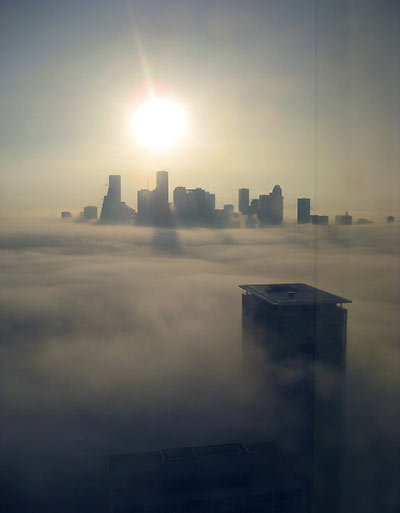 Taking cues from the Blur building, and looking through their beautiful book Blur: The Making of Nothing, Diller and Scoffidio created a cloud enveloping their architecture through spraying mist. I want to take that idea one step further. I want to make a real cloud, or at least fog. My ambitions in generating a cloud are to use it to capture water from the atmosphere and purify it to disseminate it to the city. A larger goal is to use this system to capture the particulates that cause smog and acid rain.
 In order to create a cloud, several steps must be taken. Essentially the way to create a cloud is to raise the humidity of the atmosphere to 100% by lowering the ambient air temperature to the dew point temperature. Also particulates such as dust or salt must be added to the atmosphere for the water vapor to coalesce upon something and condense. Within my site, I could use the floor slabs as cooling units by running cold water through or around them. The slabs will lower the warmer air temperature around the site (hopefully) until the local air temperature reaches the dew point. Additionally, I could use misters to help raise the humidity level in the air. From there I add particulates to the air such as dust, iodine, salt, or other miniscule minerals upon which the water vapor coalesces. Lastly, silver idodide or salt--minerals similar in structure to ice-- are added to the cloud to induce the fall of rain, a process called cloud seeding. The rain collected to the clouds would then be collected on the slabs, and channeled to a purifying system- be it christmas trees, fish farm, and brew pub, or by other means, then transferred out of the system to the city, or back through it.
After looking through Infranet Lab's website today, an important thought occurred to me about my project. The project will need an overflow area for when the site has too much water to handle in the system. Perhaps this exists as a pool? Maybe it is an area that reveals and hides itself depending upon the amount of water in it? Maybe it is like a toilet, and when fills up too much has a kinetic change? (In the case of a toilet it stops filling up)

Friday, February 26, 2010
Trip to Williamsburg and Midterm Review

Our trip to Williamsburg New York was very insightful and revealed many of the realities of our site and the situation in New York City to me. Our overall project for this semester is to create an installation, program, atmosphere, or pretty much any development of an abandoned or stalled construction site. New York City, specifically Williamsburg is riddled with sites that are prime for our investigations, while simultaneously being a danger and eyesore to the rest of the city.
One of the first stops on our trip was to a real estate broker's firm, David Maundrell. He is one of the New Yorkers who is making the most noise about the problems of the stalled sites. He explained to us the cause of the construction halts, and what he hopes to see come from the situation. Our studio then visited a few of the over 500 stalled construction sites in New York City. Over 100 of them are in Williamsburg alone. The next day, David allowed us an incredible way to experience the problems of Williamsburg--from the top of one of his real estate holdings--. From on top of his building, I noticed the site that I would choose to be the basis for my project.
 I appreciate the site, because of its raw structure that is visible. The structure that is evident is similar to the structure of the skyscrapers that exist across the river in Manhattan. I perceive my site as being on a structural grid that spans across the city. Because of the design of square blocks, I imagine that all of the structures of buildings in New York line up and are all a part of one framing plan. Rather than being owned by the landlords, the columns, beams, girders, and slabs are all an infrastructure that is provided by the city. Similar to our desks in studio, we utilize, build on, destroy, inhabit, and sleep on, yet at the end of the semester they are still a part of the larger studio.
 The site also has incredible visibility, both through it and into it. Its components and inhabitants are laid bare. Conversely, it also has the potential to be expanded beyond its footprint, because of its lack of walls. Connections can be made to neighboring buildings, and resources can be passed.
On the way back from New York City, and in the 2 weeks that followed, I developed a long list of potential programs that could inhabit my site. Fish Farm, Ice Skating Rink, Farmer's Market, Park, Playground, Brew/Pub, Movie Theatre, Constructed Wetlands, Swimming Pool, Mini Golf, Christmas Tree Farm, Wind Farm, Car Wash, Wheat Grass Farm, Sculpture Park, Hot Tub Park, Pet Shop, Car Hostel, Urban Farm, Skatepark, Cafe, or Ice Cream Shop could all inhabit my project. The first step in our design process was to develop an analysis of the components of our site. Building materials, energies, permit violations, and neighbors were all considered.


During our checkup review two weeks after the trip, I presented these drawings as analyses of my investigation of the site. Unfortunately, a disconnect was revealed between the large amount of programs that I had been developing for the site, and the notational analyses I had drawn. Vaughn, a fellow student in my studio, who is developing the same site as I, brought up an important point about the stalled construction sites. I learned from him that the sites are not bound by their footprint, or the highest slab that has been built, but in fact the greatest potential of the sites is that they do not have an envelope. They can expand and flux past this barrier of what was originally designed as the threshold by the original architect. I had been considering this as an obstruction, even though nothing was preventing me from viewing it as other than that. My experience of buildings had embedded that thinking in me. This realization led me to reconsider what my site can offer me for exploration.
In between the check-up review and the mid-review, I tried to develop a polemic for what my project was proposing. Originally I struggled with this, trying to find a way to connect my programs to my analysis. Some precedents that were brought up in my check-up review were Delirious New York, and the Hanover Pavilion by MVRDV.
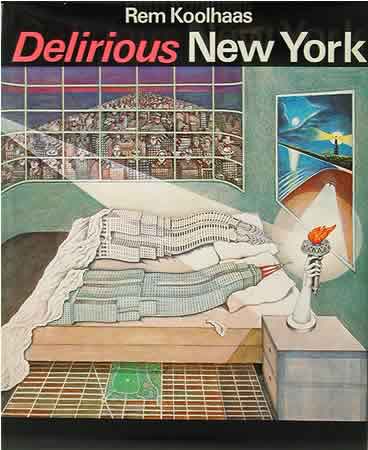

I studied these projects, and after reconsidering what I had developed so far, came up with an idea of what my project could be.
I developed the idea of my project existing within the structural grid of the city, as I explained earlier, and placed that within the context of Koolhasss' writings. I imagine that my project, with the transparency that it offers, allows the juxtapositions seen in programming the skyscrapers of Manhattan to be visible. It could show how unrelated programs could be stacked, and create a unique atmosphere on every floor.
I also considered the Hanover Pavilion. The project combines nature and technology to develop a proposal for a way to increase simultaneously quality of life and density. It uses natural systems to produce and purify energy and resources.
From these two precedents, and the disparate programs that I imagined, I developed a polemic for what my project could be come. My mid-review proposal was for a juxtaposition of stacked programs that all were developed around the use, capture, display, and refreshment of a resource. Light, water, electricity, or wireless connections could all be viable. The programs that I had were developed through a few parameters. The programs had to be able to be experienced outdoors, and most of which would have to be able to generate their own revenue, as a way to make the project a bit more likely to be realized. The programs together would exist within the life of a specific resource. Each would contribute some development of the resource through its specific use of the resource. My proposal I developed for the review was for a Swimming Pool, Car Hostel, Christmas Tree Farm, Fish Farm/Aquaculture, and a Brew/Pub, stacked in that order. My development of the project tested many of these programs together, and were shown in the review, however this combination seems to be the most viable currently.

It is difficult to describe where the life of the water begins, since it works cyclically through the project. I will begin with the car hostel, which is the first program that I developed, and a bit dear to my heart in the project. It expensive to stay in New York, and it is also expensive as well as difficult to park in the city. If you live within driving distance to the city, as I did, you never drive there if you want to visit. A car hostel is a way to merge these two needs into one, by providing a place where you can sleep in your car. The hostel provides showers and bathrooms as well as security provided by both the density of use of the project, and by minimal staff that would be needed. I imagine it to be actually a safer way to park your car in the city. The greywater that is generated in the showers and bathrooms is sprayed onto the christmas tree farm below, and seeps through the soil into the fish farm below the christmas tree farm. Through the combination of the two farms, the water is purified, and then passed into the Brew/Pub below. As a stage in the brewing process, the water is purified a third time, most likely through UV filtration. Beer is then brewed and sold to customers, who in turn return the water back into the cycle in the bathrooms. The purified water is also sent up to the bathrooms in the car hostel, and to the swimming pool, and the cycle is repeated.
I also have an interest in a transfer of resources beyond my buildings' footprint. In my proposals I had drawn a space frame/truss that connected the to buildings beyond from my own that would trade water for other resources, such as electricity or internet. In my review this was noted, and asked to be incorporated in a more rigorous manner.
What happens when the construction starts up again to my project? That was a question that was raised in my review, which sparked a new direction in which to orient my project. The stacked programs that would be introduced would require a significant amount of infrastructural piping running through the structure. What would my project be like if the infrastructure was maintained when the construction site turned back on. How would a residential loft utilize the pipes, aquariums, dirt, trees, and kegs that are intrinsic to the needs of the previous inhabitants? How are these utilities built into a structure that has no "poche space" or walls? Does it become the main organizer of the interior architecture? My project suddenly has two lives. It is a structure re-appropriated three times. from construction site to outdoor farming and business center to residential lofts. Does it leave the possibility to be refurbished after the residential lofts, or is that the last stage of project? Could it be a project that is never in a final state? What if the demolition of the lofts creates a 4th inhabitation of the project?
Other considerations of the new direction of the project were to be decisive about the amount of new construction that is added in to generate the Swimming Pool, Car hostel, Farm, etc. proposal. Another is to have a strong development of the top and bottom floors, where the resource of water is added and disseminated into the project in the form of rainwater collection and sewers. A precedent to look at is the Pompidou Centere in Paris

As spring break is upon us, I am trying to decide the ways in which to work next in order to develop this new direction. Do I work simultaneously on both the current proposal and the residential refurbishment? Do I develop them hermetically, and then merge their needs? Do I even continue to use the specific programs that i have developed? Should I know become very specific about the needs of each program in terms of pipes and systems, and use those to determine their placements? Although I am not positive, there must have been slots cast within the concrete slabs to slip plumbing and HVAC systems through. Do I relegate my infrastructural travels to only these moments? Initially I want to say no to this question, but my investigations need to lead me to a conclusion. Do I now begin working specifically rather than schematically? Perhaps I should devise the most minimal needs of each program, and try to develop a system for each that makes as few changes to the construction site as possible, while still letting each program work effectively. An example of this is the idea I generated for a fish farm, which is basically a plastic bag filled with water and fish that is wrapped around the stair core, and can be pushed around the slab to where the the fish can absorb the most light. (Sketches of it will be in next post, as well as schematic sketches from other ideas) For the next program to work effectively, however I at least need to maintain enough plumbing for the lofts to be viable to live in. I believe some mediation between the two methods would be the best way of progressing.
Thursday, January 28, 2010


A new year has begun, and along with it a new architectural studio. To begin the semester's theme of overconstruction, and how it relates to infrastructure, we started with a group project. Divided up into equal volumes for each member of the studio, we were given a volume of space within a larger box to develop a module for holding marbles. 8 to be exact. The original objective of the project was to hold the marbles in an "innovative way". This prompt developed into many schemes for the containment of marbles, some working between neighbors, others were individual.
 For my first interation of my studioblock volume, I was interested in using the marbles as a ball bearing. The marbles are on a track surrounding a box, and use the pressure provided by the space between the track and box to hold the box in place. With this setup, in theory, the box is able to move freely within the confines dictated by the track, while the marbles can roll around the box along the track. Unfortunately, at the corners of the track, the marbles have a bit more space to move around in, and thus are able to exit the track, and cause the box to fall out.
After our first review, I struggled with the fact that my volume had no
relation to its original form or its neighbors. This concern led me to
develop the idea for my next iteration. I decided to flip the
original partee diagram of my studioblock, and instead have my
original volume (though slightly smaller) rest within the studioblock
collective with the pressure of the my neighbors against embedded marbles in the outside of the form, hold me in. These marbles
would be able to move around slightly in their formed retainers, which would allow my form to
roll across the neighboring studioblocks. Unfortunately, once again my precision limited the
effectiveness of my strategy, when the holes for the marbles were slightly too small for the
marbles to have a free movement within them. This was caused by the staggered layering of
chipboard. I had thought that I had left enough tolerance for this layering, however I
misjudged what was needed.
During this iteration, one of my neighbors informed me that he would like to transfer
marbles. Since I had no other purpose at the time for the inside of my volume, I obliged,
leading me to consider what would happen on the inside of the form.


For the last iteration, my neighbor and I realized that we had a very similar method of construction, and decided to have my form complete his form. The ended up being a very strong joint, and still allowed Dexter's studioblock to transfer marbles the way he had originally intended. Unfortunately, in my last iteration, I overcompensated for the tolerance for the marble retainers, and created very loose fits between the sockets and marbles. Some of the marbles fell out in the final review. In some respects my second iteration was more successful than the third.
Subscribe to:
Comments (Atom)