
Our trip to Williamsburg New York was very insightful and revealed many of the realities of our site and the situation in New York City to me. Our overall project for this semester is to create an installation, program, atmosphere, or pretty much any development of an abandoned or stalled construction site. New York City, specifically Williamsburg is riddled with sites that are prime for our investigations, while simultaneously being a danger and eyesore to the rest of the city.
One of the first stops on our trip was to a real estate broker's firm, David Maundrell. He is one of the New Yorkers who is making the most noise about the problems of the stalled sites. He explained to us the cause of the construction halts, and what he hopes to see come from the situation. Our studio then visited a few of the over 500 stalled construction sites in New York City. Over 100 of them are in Williamsburg alone. The next day, David allowed us an incredible way to experience the problems of Williamsburg--from the top of one of his real estate holdings--. From on top of his building, I noticed the site that I would choose to be the basis for my project.
 I appreciate the site, because of its raw structure that is visible. The structure that is evident is similar to the structure of the skyscrapers that exist across the river in Manhattan. I perceive my site as being on a structural grid that spans across the city. Because of the design of square blocks, I imagine that all of the structures of buildings in New York line up and are all a part of one framing plan. Rather than being owned by the landlords, the columns, beams, girders, and slabs are all an infrastructure that is provided by the city. Similar to our desks in studio, we utilize, build on, destroy, inhabit, and sleep on, yet at the end of the semester they are still a part of the larger studio.
 The site also has incredible visibility, both through it and into it. Its components and inhabitants are laid bare. Conversely, it also has the potential to be expanded beyond its footprint, because of its lack of walls. Connections can be made to neighboring buildings, and resources can be passed.
On the way back from New York City, and in the 2 weeks that followed, I developed a long list of potential programs that could inhabit my site. Fish Farm, Ice Skating Rink, Farmer's Market, Park, Playground, Brew/Pub, Movie Theatre, Constructed Wetlands, Swimming Pool, Mini Golf, Christmas Tree Farm, Wind Farm, Car Wash, Wheat Grass Farm, Sculpture Park, Hot Tub Park, Pet Shop, Car Hostel, Urban Farm, Skatepark, Cafe, or Ice Cream Shop could all inhabit my project. The first step in our design process was to develop an analysis of the components of our site. Building materials, energies, permit violations, and neighbors were all considered.


During our checkup review two weeks after the trip, I presented these drawings as analyses of my investigation of the site. Unfortunately, a disconnect was revealed between the large amount of programs that I had been developing for the site, and the notational analyses I had drawn. Vaughn, a fellow student in my studio, who is developing the same site as I, brought up an important point about the stalled construction sites. I learned from him that the sites are not bound by their footprint, or the highest slab that has been built, but in fact the greatest potential of the sites is that they do not have an envelope. They can expand and flux past this barrier of what was originally designed as the threshold by the original architect. I had been considering this as an obstruction, even though nothing was preventing me from viewing it as other than that. My experience of buildings had embedded that thinking in me. This realization led me to reconsider what my site can offer me for exploration.
In between the check-up review and the mid-review, I tried to develop a polemic for what my project was proposing. Originally I struggled with this, trying to find a way to connect my programs to my analysis. Some precedents that were brought up in my check-up review were Delirious New York, and the Hanover Pavilion by MVRDV.
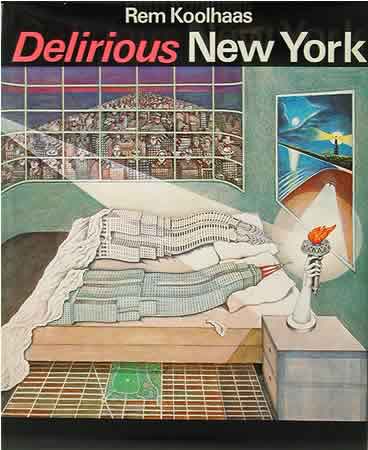

I studied these projects, and after reconsidering what I had developed so far, came up with an idea of what my project could be.
I developed the idea of my project existing within the structural grid of the city, as I explained earlier, and placed that within the context of Koolhasss' writings. I imagine that my project, with the transparency that it offers, allows the juxtapositions seen in programming the skyscrapers of Manhattan to be visible. It could show how unrelated programs could be stacked, and create a unique atmosphere on every floor.
I also considered the Hanover Pavilion. The project combines nature and technology to develop a proposal for a way to increase simultaneously quality of life and density. It uses natural systems to produce and purify energy and resources.
From these two precedents, and the disparate programs that I imagined, I developed a polemic for what my project could be come. My mid-review proposal was for a juxtaposition of stacked programs that all were developed around the use, capture, display, and refreshment of a resource. Light, water, electricity, or wireless connections could all be viable. The programs that I had were developed through a few parameters. The programs had to be able to be experienced outdoors, and most of which would have to be able to generate their own revenue, as a way to make the project a bit more likely to be realized. The programs together would exist within the life of a specific resource. Each would contribute some development of the resource through its specific use of the resource. My proposal I developed for the review was for a Swimming Pool, Car Hostel, Christmas Tree Farm, Fish Farm/Aquaculture, and a Brew/Pub, stacked in that order. My development of the project tested many of these programs together, and were shown in the review, however this combination seems to be the most viable currently.

It is difficult to describe where the life of the water begins, since it works cyclically through the project. I will begin with the car hostel, which is the first program that I developed, and a bit dear to my heart in the project. It expensive to stay in New York, and it is also expensive as well as difficult to park in the city. If you live within driving distance to the city, as I did, you never drive there if you want to visit. A car hostel is a way to merge these two needs into one, by providing a place where you can sleep in your car. The hostel provides showers and bathrooms as well as security provided by both the density of use of the project, and by minimal staff that would be needed. I imagine it to be actually a safer way to park your car in the city. The greywater that is generated in the showers and bathrooms is sprayed onto the christmas tree farm below, and seeps through the soil into the fish farm below the christmas tree farm. Through the combination of the two farms, the water is purified, and then passed into the Brew/Pub below. As a stage in the brewing process, the water is purified a third time, most likely through UV filtration. Beer is then brewed and sold to customers, who in turn return the water back into the cycle in the bathrooms. The purified water is also sent up to the bathrooms in the car hostel, and to the swimming pool, and the cycle is repeated.
I also have an interest in a transfer of resources beyond my buildings' footprint. In my proposals I had drawn a space frame/truss that connected the to buildings beyond from my own that would trade water for other resources, such as electricity or internet. In my review this was noted, and asked to be incorporated in a more rigorous manner.
What happens when the construction starts up again to my project? That was a question that was raised in my review, which sparked a new direction in which to orient my project. The stacked programs that would be introduced would require a significant amount of infrastructural piping running through the structure. What would my project be like if the infrastructure was maintained when the construction site turned back on. How would a residential loft utilize the pipes, aquariums, dirt, trees, and kegs that are intrinsic to the needs of the previous inhabitants? How are these utilities built into a structure that has no "poche space" or walls? Does it become the main organizer of the interior architecture? My project suddenly has two lives. It is a structure re-appropriated three times. from construction site to outdoor farming and business center to residential lofts. Does it leave the possibility to be refurbished after the residential lofts, or is that the last stage of project? Could it be a project that is never in a final state? What if the demolition of the lofts creates a 4th inhabitation of the project?
Other considerations of the new direction of the project were to be decisive about the amount of new construction that is added in to generate the Swimming Pool, Car hostel, Farm, etc. proposal. Another is to have a strong development of the top and bottom floors, where the resource of water is added and disseminated into the project in the form of rainwater collection and sewers. A precedent to look at is the Pompidou Centere in Paris

As spring break is upon us, I am trying to decide the ways in which to work next in order to develop this new direction. Do I work simultaneously on both the current proposal and the residential refurbishment? Do I develop them hermetically, and then merge their needs? Do I even continue to use the specific programs that i have developed? Should I know become very specific about the needs of each program in terms of pipes and systems, and use those to determine their placements? Although I am not positive, there must have been slots cast within the concrete slabs to slip plumbing and HVAC systems through. Do I relegate my infrastructural travels to only these moments? Initially I want to say no to this question, but my investigations need to lead me to a conclusion. Do I now begin working specifically rather than schematically? Perhaps I should devise the most minimal needs of each program, and try to develop a system for each that makes as few changes to the construction site as possible, while still letting each program work effectively. An example of this is the idea I generated for a fish farm, which is basically a plastic bag filled with water and fish that is wrapped around the stair core, and can be pushed around the slab to where the the fish can absorb the most light. (Sketches of it will be in next post, as well as schematic sketches from other ideas) For the next program to work effectively, however I at least need to maintain enough plumbing for the lofts to be viable to live in. I believe some mediation between the two methods would be the best way of progressing.

No comments:
Post a Comment