

 Above are just a few sketches developed for my midreview. It has been about a week since my last post, and I have been thinking a bit about my project's development so far. In the beginning stages of my development, I had an interest in my project having an involvement in the weather, and an influence in the region in which it exists rather than simply its site. I may have developed something that addresses these interests-- a cloud. I want an additional program of my project to be cloud harvesting. Besides simply having a closed loop process of obtaining water from users and returning it to them purified, I want and should gain water from other sources-notably the clouds. I am not interested however in waiting around for it to rain, or even generate a programed rain dance. Instead I want to make my own clouds--inside.
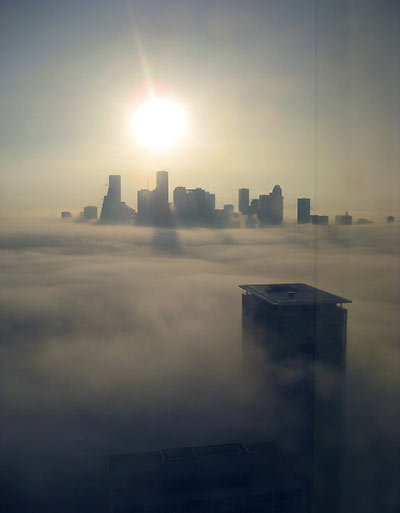 Taking cues from the Blur building, and looking through their beautiful book Blur: The Making of Nothing, Diller and Scoffidio created a cloud enveloping their architecture through spraying mist. I want to take that idea one step further. I want to make a real cloud, or at least fog. My ambitions in generating a cloud are to use it to capture water from the atmosphere and purify it to disseminate it to the city. A larger goal is to use this system to capture the particulates that cause smog and acid rain.
 In order to create a cloud, several steps must be taken. Essentially the way to create a cloud is to raise the humidity of the atmosphere to 100% by lowering the ambient air temperature to the dew point temperature. Also particulates such as dust or salt must be added to the atmosphere for the water vapor to coalesce upon something and condense. Within my site, I could use the floor slabs as cooling units by running cold water through or around them. The slabs will lower the warmer air temperature around the site (hopefully) until the local air temperature reaches the dew point. Additionally, I could use misters to help raise the humidity level in the air. From there I add particulates to the air such as dust, iodine, salt, or other miniscule minerals upon which the water vapor coalesces. Lastly, silver idodide or salt--minerals similar in structure to ice-- are added to the cloud to induce the fall of rain, a process called cloud seeding. The rain collected to the clouds would then be collected on the slabs, and channeled to a purifying system- be it christmas trees, fish farm, and brew pub, or by other means, then transferred out of the system to the city, or back through it.
After looking through Infranet Lab's website today, an important thought occurred to me about my project. The project will need an overflow area for when the site has too much water to handle in the system. Perhaps this exists as a pool? Maybe it is an area that reveals and hides itself depending upon the amount of water in it? Maybe it is like a toilet, and when fills up too much has a kinetic change? (In the case of a toilet it stops filling up)


Cloud harvesting adds a great component to your project. I don't think it is too much. Instead, I think it will very much so add a logic to your project to help make informed decisions about pipes/sprinklers/misters/overflow/etc. Seems like adding these intelligent infrastructures can really create a bizarre interconnected space of the life of water. It also adds to the definition of site to your project. Or more importantly, an expanse to that question we were talking about the other day in our group discussion about 'when do you become the designer --when does some start to experience your project.' Bring in the clouds, and sending out the water, all expand your work far (distance and conceptual) beyond the bounds of the structure that is already there. Sounds exciting!
ReplyDelete